How to Handle Client Complaints in Your Commercial Cleaning Business Without Losing the Account
A complaint is not the end of a client relationship — it is often the beginning of a stronger one, if you handle it right.
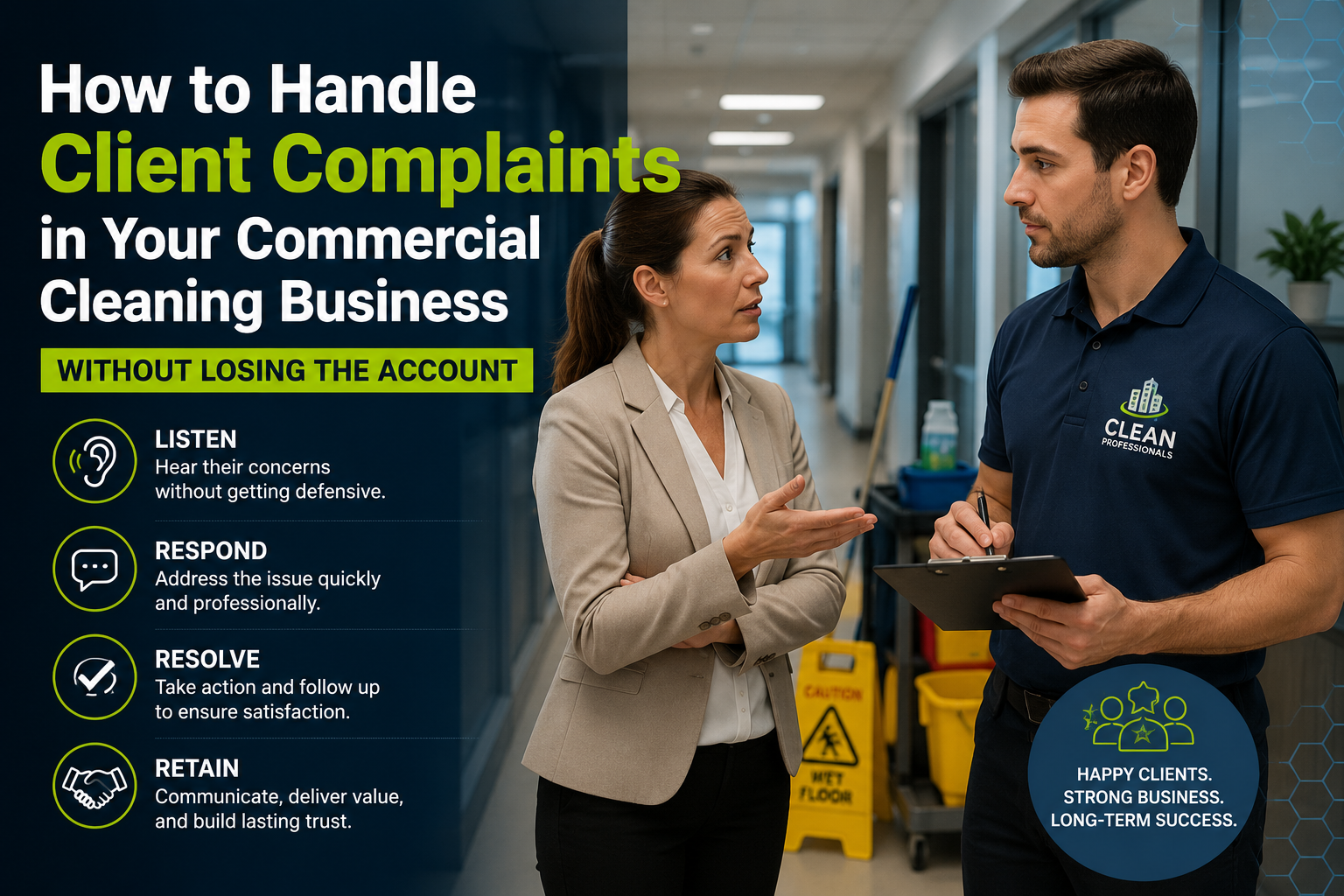
Watch: Managing Client Complaints for Your Commercial Cleaning Business
Every commercial cleaning business owner will eventually get a complaint. It does not matter how well trained your team is, how thorough your checklists are, or how long you have been in business. At some point a client will call or email saying something was missed, something was damaged, or they are simply not happy with the service.
How you respond to that moment determines everything. The cleaning companies that grow and retain accounts for years understand that complaints are not threats — they are opportunities to demonstrate the kind of professionalism that makes clients stay for the long term. The companies that lose accounts almost always lose them not because of the original mistake, but because of how they handled it.
Most clients do not leave because something went wrong. They leave because nobody seemed to care that it did.
Why complaints are actually good for your business
This sounds counterintuitive but bear with it. For every client who calls to complain, there are several who experienced the same problem and said nothing — they just quietly started looking for another cleaning company. The client who complains is actually giving you a gift: the chance to fix the issue before they walk.
Research across service industries consistently shows that a customer whose complaint is handled well is more loyal than a customer who never had a problem at all. In commercial cleaning this plays out constantly. Property managers and office managers deal with dozens of vendors. The vendor who responds to a problem quickly, professionally, and without excuses stands out immediately because most vendors do the opposite.
The five steps to handling a complaint the right way
When a client calls with a complaint the instinct is to explain, justify, or defend. Resist it completely. Let them speak without interruption. Acknowledge what they experienced with language like "I completely understand why that was frustrating" or "that is absolutely not the standard we hold ourselves to." The goal of the first minute is to make the client feel heard, not to solve the problem yet.
A clean, unconditional apology costs nothing and defuses tension immediately. Not "I'm sorry you feel that way" — that is not an apology. Not "I'm sorry but we were short staffed" — that is an excuse with a thin apology attached. Just "I'm sorry this happened and I take full responsibility for making it right." That sentence alone changes the entire tone of the conversation.
Speed of response matters more than almost anything else. If a client complains about a missed area, offer to send someone back that same day or the very next morning. Then let them know when the person is on the way, when they arrive, and when the issue is resolved. Over-communicating during the fix makes the client feel like a priority, which is exactly what they want to feel.
Most cleaning companies fix the problem and then go quiet, treating the issue as closed. The ones that retain accounts do one more thing — they call or email 24 to 48 hours later to confirm the client is satisfied. This follow-up call costs two minutes and it signals that the complaint was taken seriously beyond just the immediate fix. It is one of the simplest and most overlooked retention tools in the industry.
After each complaint log what happened, what the root cause was, and what changed as a result. Was it a training gap? A scheduling issue? A specific employee who needs coaching? Over time your complaint log becomes one of the most valuable operational documents in your business — a map of exactly where your systems need strengthening. Complaints that get documented and acted on stop repeating. Complaints that get brushed under the rug come back.
What not to do when a client complains
Getting defensive and explaining why the mistake happened before acknowledging how the client feels
Acknowledging the experience first, then briefly explaining what went wrong after the apology
Promising to "look into it" and following up days later with no clear resolution
Giving the client a specific timeline for the fix within the first conversation and sticking to it
Treating the complaint as closed once the physical issue is fixed and moving on
Following up 24-48 hours after the fix to confirm satisfaction and reinforce the relationship
Blaming the employee who made the mistake in front of or to the client
Taking full ownership as the business and handling any internal accountability privately
The bigger picture — complaints as a retention strategy
In commercial cleaning your biggest revenue risk is not getting new clients — it is losing the ones you already have. Replacing a lost account takes time, marketing spend, and sales effort. Retaining an existing account costs almost nothing by comparison. Every complaint you handle well is an account you do not have to replace.
The best cleaning businesses build a complaint culture — not one where mistakes are accepted, but one where complaints are welcomed as feedback, handled with genuine urgency, and used to make the operation better. When your team knows that complaints are treated as improvement opportunities rather than failures they are more likely to surface issues proactively instead of hoping nobody notices.
That shift — from defensive to proactive — is what separates cleaning companies that stay at 10 accounts for five years from the ones that grow to 50 accounts in the same timeframe.
A note on commercial cleaning specifically
Commercial accounts operate differently from residential clients in one important way — the person complaining is usually not the decision maker. An office manager might call you about a dirty restroom but the building manager or property owner is the one who decides whether to renew the contract. This means every complaint interaction is essentially a performance review in front of someone who reports upward.
Handle the office manager's complaint professionally and promptly, and you can be sure they tell their supervisor that the cleaning company took it seriously. Handle it poorly and the same report goes in the other direction. In commercial cleaning your reputation is built one complaint resolution at a time as much as it is built on the quality of the cleaning itself.
Tools like SqueakyLeads help cleaning business owners connect with vetted workers who understand professionalism and accountability — because ultimately the quality of your complaint response starts with the quality of your team on the ground.
Find your next cleaning job on SqueakyLeads
Browse open jobs, get notified by county, and grow your cleaning business.